week fifteen
Frailty, thy name is woman
Hamlet:
Heaven and earth,
Must I remember? Why, she would hang on him
As if increase of appetite had grown
By what it fed on, and yet, within a month—
Let me not think on't—Frailty, thy name is woman!—
Hamlet Act 1, scene 2, 142–146
Hamlet, in his first soliloquy, recalls tender scenes between his mother, Queen Gertrude, and her deceased husband. What irks Hamlet is that, after his mother had seemed so sexually dependent on the old king, she could turn around within a month of his death and marry her brother-in-law Claudius, who, Hamlet claims, is "no more like my father/ Than I to Hercules" (lines 152–153) and compares to his father as "Hyperion to a satyr" (line 140)—as the sun-god to a deformed goat-man.
To Hamlet, his mother is the archetypal woman. Her incestuous inconstancy moves him to exclaim, "Frailty, thy name is woman!" It's not so much that Hamlet is a misogynist as that his mother's sexuality has poisoned his own, as we shall see in his relations to Ophelia [see GET THEE TO A NUNNERY].

"To be, or not to be..." is the opening phrase of a soliloquy in the "Nunnery Scene" of William Shakespeare's play Hamlet.
In the speech, a despondent Prince Hamlet contemplates death and suicide. He bemoans the pains and unfairness of life but acknowledges the alternative might be still worse. The speech functions within the play to explain Hamlet's hesitation to directly and immediately avenge his father's murder (discovered in Act I) on his uncle, stepfather, and new king Claudius. Claudius and his minister Polonius are preparing to eavesdrop on Hamlet's interaction with Ophelia.

The New Testament is the second major part of the Christian biblical canon, the first part being the Old Testament, based on the Hebrew Bible. The Greek New Testament discusses the teachings and person of Jesus, as well as events in first-century Christianity. Christians regard both the Old and New Testaments together as sacred scripture. The New Testament (in whole or in part) has frequently accompanied the spread of Christianity around the world. It reflects and serves as a source for Christian theology and morality. Both extended readings and phrases directly from the New Testament are also incorporated (along with readings from the Old Testament) into the various Christian liturgies. The New Testament has influenced religious, philosophical, and political movements in Christendom, and left an indelible mark on literature, art, and music.The New Testament is an anthology, a collection of Christian works written in the common Greek language of the first century, at different times by various writers, who were early Jewish disciples of Jesus. In almost all Christian traditions today, the New Testament consists of 27 books.
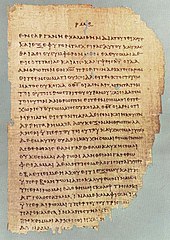
A gospel is an account describing the life, death, and resurrection of Jesus of Nazareth. The most widely known examples are the four canonical gospels of Matthew, Mark, Luke, and John which are included in the New Testament, but the term is also used to refer to apocryphal gospels, non-canonical gospels, Jewish-Christian gospels, and gnostic gospels.
Christianity places a high value on the four canonical gospels, which it considers to be a revelation from God and central to its belief system.Christianity traditionally teaches that the four canonical gospels are an accurate and authoritative representation of the life of Jesus, but more liberal churches and many scholars believe that not everything contained in the gospels is historically reliable. For example, professor of religion Linda Woodhead notes some scholarship reinforces the claim that "the gospels' birth and resurrection narratives can be explained as attempts to fit Jesus’s life into the logic of Jewish expectation". However, New Testament scholar N. T. Wright holds firmly to the historical authenticity of the death and resurrection of Jesus, stating that of the whole Bible, this is the story with the most overwhelming historical evidence.
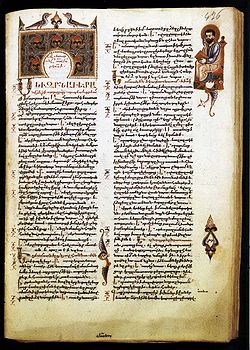
The Book of Revelation, often known simply as Revelation or The Apocalypse of John, is a book of the New Testament that occupies a central place in Christian eschatology. Its title is derived from the first word of the text, written in Koine Greek: apokalypsis, meaning "unveiling" or "revelation". The Book of Revelation is the only apocalyptic document in the New Testament canon (although there are short apocalyptic passages in various places in the Gospels and the Epistles).
The author names himself in the text as "John", but his precise identity remains a point of academic debate. Second century Christian writers such as Justin Martyr, Irenaeus, Melito the bishop of Sardis, and Clement of Alexandria and the author of the Muratorian fragment identify John the Apostle as the "John" of Revelation.Modern scholarship generally takes a different view, and many consider that nothing can be known about the author except that he was a Christian prophet. Some modern scholars characterise Revelation's author as a putative figure which they call "John of Patmos". The bulk of traditional sources date the book to the reign of the emperor Domitian (AD 81-96), and the evidence tends to confirm this.

The Second Coming is a poem composed by Irish poet W. B. Yeats in 1919, first printed in The Dial in November 1920, and afterwards included in his 1921 collection of verses Michael Robartes and the Dancer. The poem uses Christian imagery regarding the Apocalypse and second coming allegorically to describe the atmosphere of post-war Europe. The poem is considered a major work of Modernist poetry and has been reprinted in several collections, including The Norton Anthology of Modern Poetry.

The Immaculate Conception, according to the teaching of the Catholic Church, was the conception of the Blessed Virgin Mary in the womb of her mother, Saint Anne, free from original sin by virtue of the foreseen merits of her son Jesus Christ. The Catholic Church teaches that Mary was conceived by normal biological means, but God acted upon her soul (keeping her "immaculate") at the time of her conception.
The Immaculate Conception is commonly and mistakenly taken to mean the conception of Mary's son Jesus Christ in her own womb, and the Virgin Birth of Jesus. These are covered by the Doctrine of Incarnation, while the Immaculate Conception deals with the conception of Mary herself, not that of her son.

The Immaculate Collection is the first greatest hits album by American singer Madonna. It was released on November 9, 1990, by Sire Records and Warner Bros. Records. It contains new remixes of fifteen of her hit singles from 1983 to 1990, as well as two new tracks, "Justify My Love" and "Rescue Me". The title of the album is a loose pun on the Immaculate Conception, the conception of the Virgin Mary without the stain of original sin. An extended play titled The Holiday Collection was issued in Europe to accompany the compilation and the re-release of the single "Holiday". It is the first album ever to use an audio technology called QSound.


Thomas Dooley (born December 5, 1961) is a retired American soccer defender and defensive midfielder, a long-time member and former captain of the United States national team. Dooley is the current head coach of the Philippines national team.
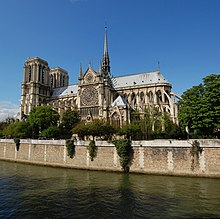
Notre-Dame de Paris , also known as Notre-Dame Cathedral or simply Notre-Dame, is a historic Catholic cathedral on the eastern half of the Île de la Cité in the fourth arrondissement of Paris, France.The cathedral is widely considered to be one of the finest examples of French Gothic architecture, and it is among the largest and most well-known church buildings in the world. The naturalism of its sculptures and stained glass are in contrast with earlier Romanesque architecture.
The Lord's Prayer, also called the Our Father and the Pater Noster,is a venerated Christian prayer that, according to the New Testament, was taught by Jesus to his disciples. Two forms of it are recorded in the New Testament: a longer form in the Gospel of Matthew as part of the Sermon on the Mount, and a shorter form in the Gospel of Luke as a response by Jesus to a request by "one of his disciples" to teach them "to pray as John taught his disciples" concludes with "deliver us from evil" in Matthew, and with "lead us not into temptation" in Luke. The first three of the seven petitions in Matthew address God; the other four are related to human needs and concerns. The liturgical form is the Matthean. Some Christians, particularly Protestants, conclude the prayer with a doxology, a later addendum appearing in some manuscripts of Matthew.
The prayer as it occurs in Matthew 6:9–13
Our Father in heaven,
hallowed be your name.
Your kingdom come,
your will be done,
on earth, as it is in heaven.
Give us this day our daily bread,
and forgive us our debts,
as we also have forgiven our debtors.
And lead us not into temptation,
but deliver us from evil.

Braille is a tactile writing system used by people who are blind and low vision. It is traditionally written with embossed paper. Braille-users can read computer screens and other electronic supports thanks to refreshable braille displays. They can write braille with the original slate and stylus or type it on a braille writer, such as a portable braille note-taker, or on a computer that prints with a braille embosser.
Braille is named after its creator, Frenchman Louis Braille, who lost his eyesight due to a childhood accident. In 1824, at the age of 15, Braille developed his code for the French alphabet as an improvement on night writing. He published his system, which subsequently included musical notation, in 1829. The second revision, published in 1837, was the first binary form of writing developed in the modern era.

CP值 - In economics and engineering, the price/performance ratio refers to a product's ability to deliver performance, of any sort, for its price. Generally speaking, products with a lower price/performance ratio are more desirable, excluding other factors.
Price–performance is often written as cost–performance or cost–benefit. Even though this term would seem to be a straightforward ratio, when price performance is improved, better, or increased, it actually refers to the performance divided by the price, in other words exactly the opposite ratio to rank a product as having an increased price/performance.
3D - Dirty, Dangerous and Demeaning (often Dirty, Dangerous and Demanding or Dirty, Dangerous and Difficult), also known as the 3Ds, is an American neologism derived from an Asian concept, and refers to certain kinds of labor often performed by unionized blue-collar workers.
The term originated from the Japanese expression 3K: kitanai, kiken, kitsui (respectively 汚い "dirty", 危険 "dangerous", きつい "demanding"), and has subsequently gained widespread use, particularly regarding labor done by migrant workers.
Typically, any task, regardless of industry, can qualify as a 3D job. These jobs can bring higher wages due to a shortage of willing qualified individuals and in many world regions are filled by migrant workers looking for higher wages.
-------------------------------------------------------------------------------------------------------------------------
VOCABULARY
learned - (formal) having a lot of knowledge because you have studied and read a lot
feeble - very weak
acquired - acquire something to gain something by your own efforts, ability or behavior
fragmentary - (formal) made of small parts that are not connected or complete
unit 25
to suggest indirectly that something unpleasant is true synonym imply insinuate something What are you trying to insinuate?an insinuating smile
insinuate that… The article insinuated that he was having an affair with his friend's wife.
insinuate yourself into something (formal, disapproving) to succeed in gaining somebody’s respect, affection, etc. so that you can use the situation to your own advantage
In the first act, the villain insinuates himself into the household of the man he intends to kill.
insinuate yourself/something + adv./prep. (formal) to slowly move yourself or a part of your body into a particular position or place
She insinuated her right hand under his arm.
- disparity - a difference, especially one connected with unfair treatment
- forestall - forestall something/somebody (formal) to prevent something from happening or somebody from doing something by doing something first
- insidious - spreading gradually or without being noticed, but causing serious harm
- insinuate -
- interrogate -
- interrogate somebody to ask somebody a lot of questions over a long period of time, especially in an aggressive way
interrogate something (specialist) to obtain information from a computer or other machine - obsequious - trying too hard to please somebody, especially somebody who is importantsynonym servile
- omnipotent - having total power; able to do anything
- opportune -
- (of a time) suitable for doing a particular thing, so that it is likely to be successfulsynonym favourableThe offer could not have come at a more opportune moment.Chapman decided the time was opportune for talking business.It was an opportune time to look at the offer in more detail.
- (of an action or event) done or happening at the right time to be successfulan opportune remarkThe publication of the book now is quite opportune. opposite inopportune
- permeate -
- [transitive, intransitive] (of a liquid, gas, etc.) to spread to every part of an object or a placepermeate something The smell of leather permeated the room.The air was permeated with the odour of burning rubber.+ adv./prep. rainwater permeating through the ground
- [transitive, intransitive] (of an idea, an influence, a feeling, etc.) to affect every part of somethingpermeate something a belief that permeates all levels of societyA feeling of unease permeates the novel.
- retribution - [uncountable] retribution (for something) (formal) severe punishment for something seriously wrong that somebody has done
unit 26
- complement - complement something to add to something in a way that improves it or makes it more attractive
- discreet - careful in what you say or do, in order to keep something secret or to avoid causing embarrassment or difficulty for somebodysynonym tactful
- fastidious -
- being careful that every detail of something is correctsynonym meticulousEverything was planned in fastidious detail.He was fastidious in his preparation for the big day.
- (sometimes disapproving) not liking things to be dirty or untidyShe wasn't very fastidious about personal hygiene.
- flout - flout something to show that you have no respect for a law, etc. by openly not obeying itsynonym defy
- heinous - morally very bad
- implement - implement something (formal) to make something that has been officially decided start to happen or be usedsynonym carry something<=>out
- impromptu - done without preparation or planningsynonym improvise
- inference -
- [countable] something that you can find out indirectly from what you already knowsynonym deductionto draw/make inferences from the dataThe clear inference is that the universe is expanding.
- [uncountable] the act or process of forming an opinion, based on what you already knowIf he is guilty then, by inference, so is his wife (= it is logical to think so, from the same evidence).
- intuition -
- [uncountable] the ability to know something by using your feelings rather than considering the factsIntuition told her that he had spoken the truth.He was guided by intuition and personal judgement.The answer came to me in a flash of intuition.
- [countable] intuition (that…) an idea or a strong feeling that something is true although you cannot explain whyI had an intuition that something awful was about to happen.
- obtrusive - noticeable in an unpleasant way

沒有留言:
張貼留言